

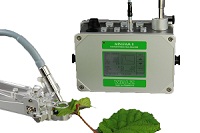
超便携式调制叶绿素荧光仪


主要功能
-
可测荧光诱导曲线并进行淬灭分析
-
可测光响应曲线和快速光曲线(RLC)
-
全部采用 LED 光源,全新触摸屏设计
-
新增湿度测量功能,新增远红光源
-
仪器更加便携,适合野外测量
-
可通过微光纤与光合仪(如 GFS-3000)联用
-
采用5号电池供电,备用电池易获得,适合长期野外使用
测量参数
Fo, Fm, F, Fm', Fo’, Fv/Fm, Y(II) 即 ΔF/Fm', qP, qL, qN, NPQ, Y(NPQ), Y(NO), rETR, PAR、叶温和相对湿度等。
应用领域
研究光合作用机理、各种环境因子(光、温、营养等)对植物生理生态的影响、植物抗逆性(干旱、冷、热、UV、病毒、污染等)、植物的长期生态学变化等。
在植物生理学、植物生态学、植物病理学、农学、林学、园艺学、水生生物学、环境科学等领域有着广泛应用。
主要技术参数
-
测量光:蓝光 LED(470 nm)或红光 LED(655nm),光强 0.05 µmol m-2 s-1。
-
光化光:蓝光 LED(470 nm)或红光 LED(655nm),最大连续光强 3000 μmol m-2 s-1。
-
饱和脉冲:蓝光 LED(470 nm)或红光 LED(655nm),最大闪光强度 6000 μmol m-2 s-1。
-
远红光:发射峰值 740 nm。
-
信号检测:PIN-光电二极管,带长通和短通滤光片,带选择性锁相放大器。
-
数据存储:8M 存储卡,可存储 27000 组数据。
-
叶夹:2035-B 叶夹包含 MINI-PAM/ F 光纤放置口和样品夹。叶夹上下两部分打开后可以夹住叶片。夹子上面部分提供了一个直径为 1 厘米圆形测量面积。光纤尖端与测量区域之间的标准距离为 8 mm。光纤与测量平面呈 60° 角。叶片温度传感器安装在测量区域下方。湿度传感器安装在距离测量区域 3cm 的位置。内置芯片保存传感器的校准数据。饱和脉冲可以通过遥控触发按钮被释放。另外提供一个附加光传感器输入接口。PAR 测量范围 0-7000 µmol m-2 s-1,叶片温度测量范围 -20 至 +60℃,湿度测量范围 0-100%RH。
-
供电:6 节 AA(5 号 1.2 V/2 Ah)可充电电池,充电一次可供 1000 次饱和脉冲闪光。
选购指南
一、高等植物叶片测量基本款
系统组成:主机,光纤,光适应叶夹,暗适应叶夹,软件等
注意:高等植物叶片红光版和蓝光版(推荐)主机可选其一
 |
| 高等植物叶片测量基本款 |
二、悬浮样品测量基本款
系统组成:主机,光纤,悬浮样品室,磁力搅拌器,光纤测氧仪(选配),软件等
注意:藻类测量时,建议选择红光版主机
 |
| 悬浮样品测量基本款 |
 |
 |
 |
 |
 |
 |
三、其他可选附件
-
外置 LED 光源:2054-L。
-
可以连接到 2035-B 叶夹上提供外置光化光,红绿蓝白 4 色,最大激发波长分别为 630 nm 红光, 520 nm 绿光, 452 nm 蓝光和波长范围 450nm-680nm 的白光。每种波长的光标准最大光强为 1500µmol m-2 s-1 连接外部供电装置情况下,整体最大光强可达 6000µmol m-2 s-1 颜色组合可以自由选择。
-
90 度角光纤适配器:2030-B90 。
-
安装在 2030-B 或 2060-B 上,使光纤与样品成 90 度角。
-
微型光量子/温度传感器:2065-M。
-
测量 PAR 和温度,可连接 MINI-PAM 后独立使用,多与 2060-B 结合使用。
-
大样品表面光纤固定支架:2060-A。
-
将光纤固定在较大样品的表面(非叶片),与 2065-M 结合使用。
-
拟南芥叶夹:2060-B。
-
60 度角光适应叶夹,与独立微型光量子/温度传感器 2060-M 连用进行测量,特别适于测量拟南芥类小叶片。需配置 2060-M。
-
微光纤:MINI-PAM/F1。
-
直径 2 mm,长 1.5 m,用于测量小样品。包括连接到 2035-B 的适配器。
应用示例
 |
 |
 |
产地:德国WALZ
参考文献
数据来源:光合作用文献 Endnote 数据库,更新至 2021 年 1 月,文献数量超过 10000 篇
原始数据来源:Google Scholar
注:MINI-PAM-II 为 MINI-PAM 新升级产品,更多文献可参考 MINI-PAM 文献目录
Gong, X., et al. (2021). "Intercropping combined with nitrogen input promotes proso millet (Panicum miliaceum L.) growth and resource use efficiency to increase grain yield on the Loess plateau of China." Agricultural Water Management 243: 106434.
Afzal, M. J., et al. (2020). "Combined application of Bacillus sp. MN-54 and phosphorus improved growth and reduced lead uptake by maize in the lead-contaminated soil." Environmental Science and Pollution Research.
Andrzejczak, O. A., et al. (2020). "The Hypoxic Proteome and Metabolome of Barley (Hordeum vulgare L.) with and without Phytoglobin Priming. ." Int. J. Mol. Sci(21): 1546.
Casadesús, A., et al. (2020). "Differential accumulation of tocochromanols in photosynthetic and non-photosynthetic tissues of strawberry plants subjected to reiterated water deficit." Plant Physiology and Biochemistry 155: 868-876.
CHEN Li-li, W. H.-y., GONG Xiao-chen, ZENG Zhao-hai, XUE Xu-zhang, HU Yue-gao (2020). "Transcriptome analysis reveals effects of red and blue light-emitting diodes (LEDs) on the growth, chlorophyll fluorescence and endogenous plant hormone of potato (Solanum tuberosum L.) plantlet cultured in vitro." 2020: 0-.
Czarnes, S., et al. (2020). "Impact of soil water content on maize responses to the plant growth-promoting rhizobacterium Azospirillum lipoferum CRT1." 206(5): 505-516.
Hu, L., et al. (2020). "Microplastics generated under simulated fire scenarios: Characteristics, antimony leaching, and toxicity." Environmental Pollution: 115905.
Huang, D., et al. (2020). "Silencing MdGH3-2/12 in apple reduces cadmium resistance via the regulation of AM colonization." Chemosphere: 129407.
Kaiser, E., et al. (2020). "Photorespiration Enhances Acidification of the Thylakoid Lumen, Reduces the Plastoquinone Pool, and Contributes to the Oxidation of P700 at a Lower Partial Pressure of CO2 in Wheat Leaves." Plants (Basel) 9(3): 319.
Khan, H., et al. (2020). "Effective Control against Broadleaf Weed Species Provided by Biodegradable PBAT/PLA Mulch Film Embedded with the Herbicide 2-Methyl-4-Chlorophenoxyacetic Acid (MCPA)." ACS Sustainable Chemistry & Engineering 8(13): 5360-5370.
Kim, J.-H., et al. (2020). "Global warming offsets the ecophysiological stress of ocean acidification on temperate crustose coralline algae." Marine pollution bulletin 157: 111324.
Liu, C., et al. (2020). "Low-nitrogen tolerance comprehensive evaluation and physiological response to nitrogen stress in broomcorn millet (Panicum miliaceum L.) seedling." Plant Physiology and Biochemistry 151: 233-242.
Martins, J. P. R., et al. (2020). "Morphophysiological responses, bioaccumulation and tolerance of Alternanthera tenella Colla (Amaranthaceae) to excess copper under in vitro conditions." Plant Cell, Tissue and Organ Culture (PCTOC).
O'Brien, M. J., et al. (2020). "Foundation species promote local adaptation and fine-scale distribution of herbaceous plants." n/a(n/a).
O’Connell, E. and J. Savage (2020). "Extended leaf phenology has limited benefits for invasive species growing at northern latitudes." Biological Invasions.
P.S, C., et al. (2020). "Cadmium biosorption and biomass production by two freshwater microalgae Scenedesmus acutus and Chlorella pyrenoidosa: An integrated approach." Chemosphere: 128755.
Pérez-Molina, J., et al. (2020). "Chlorophyll fluorescence and biomass partitioning within light and nitrogen deficiency: An example of the use of the R programming language for teaching." UNED Research Journal 12: 2629.
Rasool, G., et al. (2020). "Effect of Buried Straw Layer Coupled with Fertigation on Florescence and Yield Parameters of Chinese Cabbage Under Greenhouse Environment." Journal of soil science and plant nutrition.
Röhlen-Schmittgen, S., et al. (2020). "Boosting leaf contents of rutin and solanesol in bio-waste of Solanum lycopersicum." Plant Physiology and Biochemistry.
Rosa Guadalupe, P.-H., et al. (2020). "Physiological and microclimatic consequences of variation in agricultural management of maize." Botanical Sciences(0).
Setsungnern, A., et al. (2020). "A defect in BRI1-EMS-SUPPRESSOR 1 (bes1)-mediated brassinosteroid signaling increases photoinhibition and photo-oxidative stress during heat stress in Arabidopsis." Plant Science 296: 110470.
Sinclair, M. N., et al. (2020). "Seasonal facilitative and competitive trade-offs between shrub seedlings and coastal grasses." Ecosphere 11(1): e02995.
Song, H., et al. (2020). "Differences in relative air humidity affect responses to soil salinity in freshwater and salt marsh populations of the dominant grass species Phragmites australis." Hydrobiologia.
Wada, S., et al. (2020). "Photorespiration Enhances Acidification of the Thylakoid Lumen, Reduces the Plastoquinone Pool, and Contributes to the Oxidation of P700 at a Lower Partial Pressure of CO2 in Wheat Leaves." Plants(9): 319.
Wang, L., et al. (2020). "Chloride salinity in a chloride-sensitive plant: Focusing on photosynthesis, hormone synthesis and transduction in tobacco." Plant Physiology and Biochemistry.
Wongnoi, S., et al. (2020). "Physiology, Growth and Yield of Different Cassava Genotypes Planted in Upland with Dry Environment during High Storage Root Accumulation Stage." Agronomy(10): 576.
Yañez-Serrano, A. (2020). "Heat Waves Change Plant Carbon Allocation Among Primary and Secondary Metabolism Altering CO2 Assimilation, Respiration, and VOC Emissions." Frontiers in Plant Science 11.
Zhang, Q., et al. (2020). "Identification of drought tolerant mechanisms in a drought-tolerant maize mutant based on physiological, biochemical and transcriptomic analyses." BMC Plant Biology 20(1): 315.
Zhang, X., et al. (2020). "Photosynthetic Properties of Miscanthus condensatus at Volcanically Devastated Sites on Miyake-jima Island." Plants(9): 1212.
Zhong, C., et al. (2020). "Ultrastructural evolution, physiological traits, and carbon and nitrogen assimilation–related gene expression are compatible with the developmental transitions of parthenogenesis in Pyropia haitanensis (Bangiales, Rhodophyta)." Journal of Applied Phycology.
Zou, W., et al. (2020). "The Influence of Size and Phase on the Biodegradation, Excretion, and Phytotoxicity Persistence of Single-Layer Molybdenum Disulfide." Environmental Science & Technology.
Hatam, Z., et al. (2020). "Zinc and potassium fertilizer recommendation for cotton seedlings under salinity stress based on gas exchange and chlorophyll fluorescence responses." South African Journal of Botany 130: 155-164.
Son, K.-H., et al. (2020). "Growth characteristics and phytochemicals of canola (Brassica napus) grown under UV radiation and low root zone temperature in a controlled environment." Horticulture, Environment, and Biotechnology.
Wang, Q.-W., et al. (2020). "Testing trait plasticity over the range of spectral composition of sunlight in forb species differing in shade tolerance." Journal of Ecology n/a(n/a).
上海泽泉科技股份有限公司(Zealquest Scientific Technology Co., Ltd.)成立于2000年,是一家专注于高端科研设备研发、系统集成、技术推广、咨询、销售和科研服务的科技型技术企业。公司注册资金3500万元人民币,具有进出口贸易权。
公司总部位于上海浦西,在北京设有分公司,在广州、成都、武汉分别设有代表处。公司全体员工均具有高等教育背景,其中80%的技术研发、技术支持和销售人员具有硕士和博士学位,参加过很多国家和省部级重大科研项目,具有丰富的科研工作经验。公司曾获得上海市高新技术企业、上海市普陀区科技小巨人企业、上海市科技型企业中华全国工商联合会/上海市工商联合会/上海市商会会员单位,曾是上海市专业技术服务平台——生理生态测量与分析平台的依托单位和上海市高新技术成果转化项目承担单位。2012年公司通过了ISO9001质量管理体系认证,获得AAA级信用资质等级认定,获得普陀区科技小巨人企业认定,成为上海市研发公共服务平台加盟单位和“上海市工商联合会”/“上海市商会”会员单位 。2015年获得“专精特新”中小企业认定。2016年成为“上海市生态学学会常务理事单位”和“上海种子行业协会”会员单位,2017年成为“上海市农业工程学会理事单位”。
上海泽泉科技股份有限公司非常注重自主知识产权的申报和保护,公司及子公司上海乾菲诺农业科技有限公司截止2024年底已获得发明专利8项、实用新型54项及软件著作9项,国内外科研期刊发表科研论文20多篇。公司还参与承担了国家自然科学基金重点项目(41030529)和水利部948项目(200907)。
公司秉承推进中国生态环境改善、科技兴国的理念,服务涉及机器人与人工智能应用,生命科学多组学研究,植物表型与植物生理生态、生物育种技术平台建设;土壤、环境气象、水文水利与海洋等领域的最新技术资讯和产品解决方案,服务对象主要为各级科研单位、高校和政府机构。公司先后为科技部“973”项目和“863”项目、国家科技重大专项、国家科技支撑计划、国家“211”工程和“985”工程、中科院知识创新工程、农业部“948”项目、水利部“948”项目等提供技术咨询、仪器设备、系统解决方案和系统集成服务,为项目的顺利完成提供了有力支持。
多年来,公司积极参与相关领域的学术会议,并定期举办相关仪器设备的技术讲座和培训班,在科研和监测领域产生了积极的反响,获得了良好的口碑。截止2024年底,泽泉科技举办公开技术讲座275多场,参会人员超过15000人次;同时在国内外应邀参加学术会议和展会296多次,与相关领域的客户有非常密切的交流合作。
2014年2月,上海泽泉科技股份有限公司在上海浦东孙桥现代农业园区投资成立了上海乾菲诺农业科技有限公司,建设了AgriPhenoTM “高通量植物基因型-表型-育种服务平台”,为植物科研和育种单位提供全面的样品收集和栽培,实验设计和项目合作,以及表型数据与生物信息学分析综合服务。平台成功主持了上海张江国家自主创新示范区专项发展资金重点项目“泽泉科技高通量植物基因型-表型-育种服务平台”。作为主持单位或合作单位参与了上海市农委和科委的30多项政府科研服务项目以及商业服务项目,如科技兴农种业发展项目“农作物分子育种的技术创新研究”和“青菜高通量表型图谱标准的建立及主要性状分析”、科技兴农重点攻关项目“基于图像分析及三维建模技术的黄瓜长势快速评价方法研究”、 “兰科观赏花卉分子育种技术研究与产业化应用”等。为了紧追世界科技发展水平,开启院企合作建立研究型平台的创新尝试,上海泽泉科技股份有限公司与上海市农业科学院,结合双方各自的优势,于2021年5月在上海农业科学院庄行试验站联合成立“上海市农业科学院庄行综合试验站泽泉科技植物表型技术研究平台”,AgriPhenoTM平台从上海浦东孙桥现代农业园区整体迁出,并入新建的植物表型技术研究平台。目前平台除拥有无人机表型平台、温室型和实验室型高通量表型分析系统外,还拥有现代化温室、生物学实验室、植物生理生态测量设备、农业气象测量系统和专业的数据库平台,已经具备了对植物、动物基因测序与植物表型研究的各类条件。可以承担高通量DNA提取、基因测序服务、分子辅助育种、植物生理生态研究等科研实验任务。同时可以为植物功能基因组、农业育种家提供高通量植物基因型测试、高通量植物表型测试和植物基因型-表型生物信息学数据分析等开放式服务。
近年来,随着“生物技术+人工智能+大数据、信息技术”为特征的第四次种业科技革命不断孕育,国际大型种业公司规模不断扩大,种业市场集中度持续提高。生物育种是种业创新的核心,构建现代生物育种创新体系,强化种质资源深度挖掘,突破前沿育种关键技术,培育战略性新品种,实现种业科技自强自立,是解决种源要害、打赢种业翻身仗的关键,也是牢牢把握住粮食安全主动权的根本保障。在这个大背景下,2022年9月,北大荒垦丰种业、上海泽泉科技联合成立北大荒垦丰种业-泽泉科技生物技术与表型服务中心(KA-BPSC),集中优势资源、整合集体力量,为解决种业种源“卡脖子”技术难题,打赢种业翻身仗贡献力量。
展望未来,上海泽泉科技股份有限公司希望在社会多方资源的支持和关怀下,不断提升自己,为社会提供更多、更优秀的产品和一流的服务!
| 单位名称: |
|
详细地址:
上海市普陀区金沙江路1038号华东师大科技园2号楼8层
|
|
qq:
|
|
联系电话:
021-32555118
|
| Email: |
